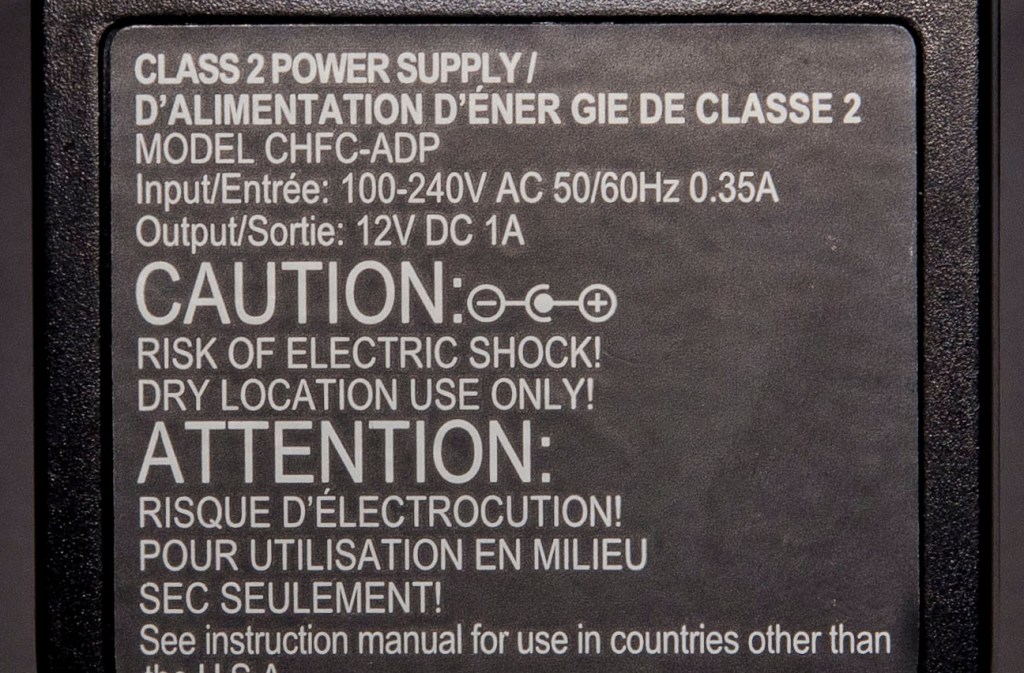
I was getting ready for an upcoming trip to Switzerland and Italy, and I picked up the power brick for my laptop to check whether it would handle European voltage. The label said INPUT: 100–240V, which is exactly what I wanted to see. I can plug it in over there with just a plug adapter, no transformer needed.
But then I stopped and looked at that number again. 100 volts. Who runs on 100 volts? The U.S. runs on 110 to 120. Europe runs on 220 to 240. Most of the world is in one of those two camps. So why does basically every power brick I own, including phone chargers, laptop supplies, and electric toothbrushes, quote a range that starts at 100 instead of 110?
I went down the rabbit hole. The answer turned out to be one of the best pieces of accidental history I’ve ever stumbled into. So this week, we’re taking a break from my electric bill to talk about Japan.
The country that runs on 100 volts
Japan is the only major country in the world where household power is nominally 100 volts. Not 110, not 120, not 220. One hundred. Everyone else clusters around either the North American standard (110 to 120V) or the European/Australian standard (220 to 240V). Japan sits by itself.
And the reason is essentially two separate stories of inertia that converged into one strange national outcome. Two competing electric companies, in two different Japanese cities, bought their first generators from two different countries within about a year of each other in the mid-1890s. Nobody coordinated. Nobody planned. And once the decisions were made, it was too expensive to undo any of it.
But it gets weirder. Japan didn’t just end up with a unique voltage. It ended up with two incompatible electrical grids inside the same country, and the country still can’t fully share power between them today. That’s the part that really got me.
Meiji-era Japan was buying everything from everyone
To understand how this happened, you have to know what Japan looked like in the 1890s. The Meiji Restoration had ended a couple of decades earlier, and Japan was in the middle of an extraordinary national project to modernize. They had spent more than 200 years deliberately sealed off from most of the outside world, and now they were trying to catch up to the industrial West in a single generation. The strategy was straightforward: figure out who was best at each thing, buy their stuff, and learn from it. Naval architecture from the British. Army organization from the Prussians, then the French. Medicine from the Germans. Universities patterned on the American and European models.
Electricity was brand new. Edison’s first commercial power station in New York had opened in 1882. By the 1890s the technology was spreading fast, but there were no international standards. Different manufacturers in different countries had settled on different frequencies, the rate at which alternating current cycles back and forth, and there was no reason to think any of it mattered yet.
So when Japanese cities started electrifying, they did what Meiji Japan did with everything else: they shopped around.
1895 and 1896: two cities, two suppliers
In 1895, the Tokyo Electric Light Company bought its first alternating-current generators from AEG, a German firm that was one of the giants of European electrical engineering at the time. Those generators ran at 50 hertz, the German standard.
The next year, in 1896, the Osaka Electric Light Company bought its first generators from General Electric in the United States. Those ran at 60 hertz, the American standard.
Tokyo and Osaka are about 500 kilometers apart. In 1896, the grids were tiny, local, and isolated. Each one served the immediate area around a single city. The idea that they would someday need to talk to each other, that there might eventually be a single national grid stretching the length of Japan, was not on anyone’s mind. Why would it be? Electric service barely reached the edge of town.
A quick note on the voltage
You might be wondering: if the German and American generators ran at different frequencies, did they also force the voltage difference? They didn’t. Voltage and frequency are independent properties of a generator, set by different design choices. The voltage story is separate, and it’s the less dramatic one.
Early electrical equipment everywhere in the world ran at relatively low voltages in the 1890s, typically around 100 to 110 volts, because that’s what Edison-era bulbs and motors were built for. The U.S. started there too. The difference is what happened next. Over the following century, the United States gradually crept up to 120 volts to reduce line losses as appliances grew more demanding. Europe pushed all the way up to 220 to 240. Japan didn’t. They started at 100 and stayed at 100.
The mid-20th-century Japanese government actually did consider raising the voltage closer to European levels. They decided not to. By that point too many homes, factories, transformers, motors, and appliances had already standardized on 100 volts. Replacing all of it nationwide was going to cost more than living with it. So they didn’t.
That’s why Japan is stuck at 100 volts. Not because of a 19th-century accident, but because of a 20th-century cost-benefit decision that said the accident wasn’t worth fixing.
The frequency split, on the other hand, is the 19th-century accident. And it gets worse over time, not better.
The grids grew until they ran into each other
Over the next few decades, electricity spread across Japan. Tokyo’s 50-hertz grid expanded eastward and northward, eventually covering Hokkaido, Tohoku, the Kanto region, and parts of central Honshu. Osaka’s 60-hertz grid spread west and south, covering Kansai, Chugoku, Shikoku, and Kyushu. By the 1920s, surveys showed that around 83 percent of the Tokyo region was on 50 Hz and 87 percent of the Osaka-Nagoya region was on 60 Hz. The two systems were no longer isolated city grids. They were regional power networks. And they were heading toward each other.
The boundary they eventually settled on runs roughly along the Fujigawa River in Shizuoka Prefecture, up through Itoigawa City in Niigata Prefecture. Cross that line and the frequency changes. Everything east of it is 50 Hz. Everything west is 60 Hz. A microwave you bought in Tokyo might not work properly in Osaka, and vice versa, depending on the model.
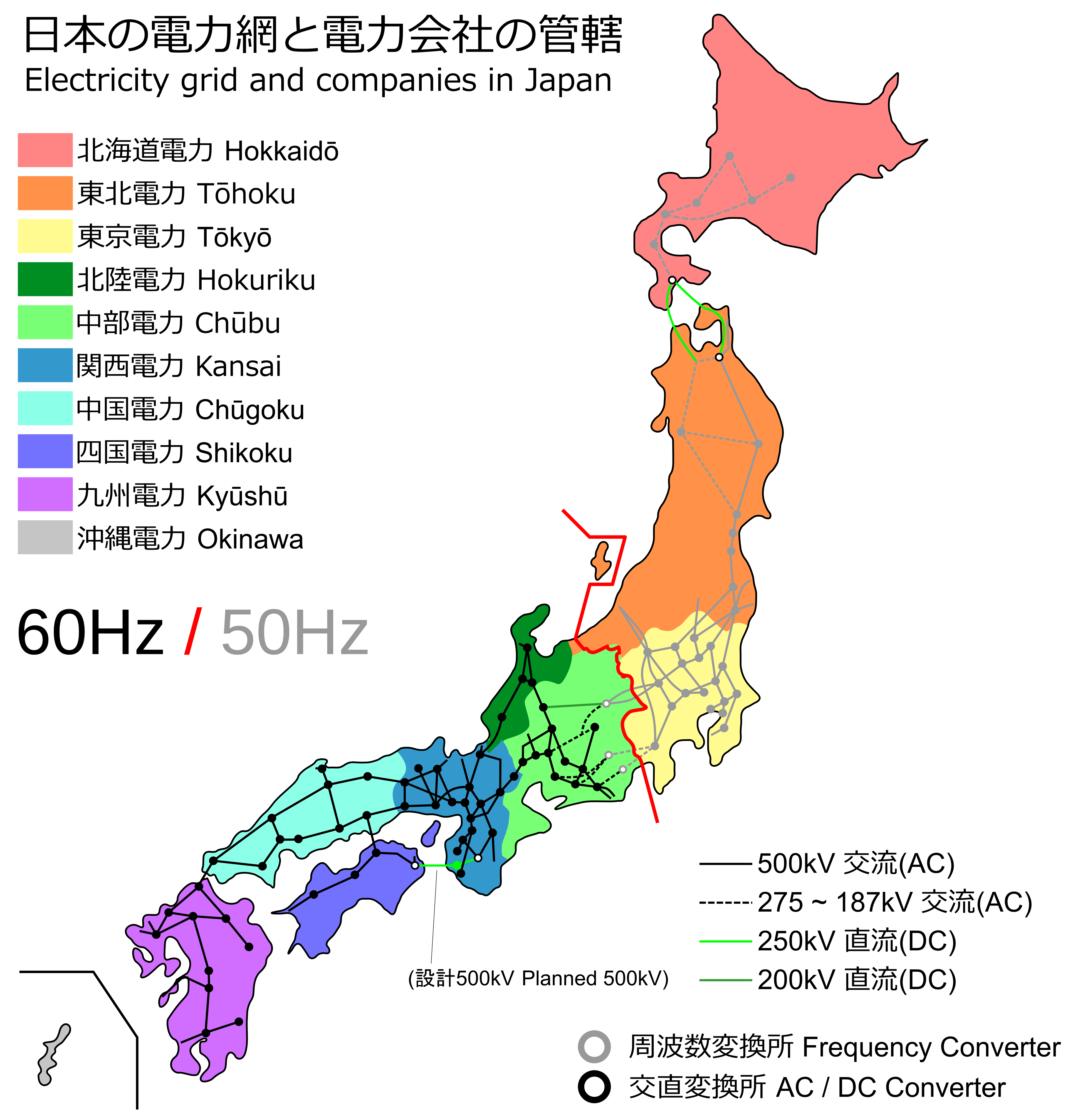
Japan is, as far as I can tell, the only country on the planet running two incompatible electrical frequencies inside its own borders. And just like with the voltage, the mid-20th-century government considered unifying the country on a single frequency and decided the cost was prohibitive. So they didn’t.
The bill from 1896 came due in 2011
For most of the 20th century, the frequency split was an inconvenience but not a crisis. The two halves of the country were connected by a small number of frequency converter stations, facilities that take AC power off one grid, convert it to DC, and then synthesize a new AC waveform at the other frequency to push it onto the other grid. There are only a handful of these stations. Their combined capacity is limited. For decades, that was good enough.
Then in March 2011, the Great East Japan Earthquake hit. The Fukushima Daiichi nuclear plant was destroyed. TEPCO, Tokyo’s utility, lost a huge chunk of its generating capacity overnight, right at the moment Tokyo needed electricity most. And the painful realization sank in: more than half of Japan’s total generating capacity was sitting on the other side of the frequency line, in the west, and there was no way to move enough of it east.
The converter stations could push around 1.2 gigawatts across the boundary in total. TEPCO needed multiples of that. The west had power to spare. The east couldn’t get to it. Tokyo went through rolling blackouts.
That moment, more than any other, made it clear that a decision two electric companies made in 1895 and 1896, without coordinating, without thinking about national infrastructure, without any reason to imagine the grids would ever meet, was still constraining Japan more than 115 years later.
They’re still paying for it
The response to 2011 included a national push to build more converter capacity, and that work is still happening right now. In October 2023, Mitsubishi Electric was awarded a contract to supply a new 300-megawatt HVDC frequency converter at the Shin-Sakuma station in Hamamatsu, Shizuoka. The system is expected to enter service by the end of March 2028. That’s a 130-year-old decision still generating engineering contracts and capital expenditures in the 2020s.
I find that detail genuinely hard to absorb. Two procurement decisions made by separate companies in separate cities in 1895 and 1896, neither one of which had any idea the other was happening, neither one of which was thinking past the next few city blocks, are still costing Japan money and constraining Japan’s grid in 2026. The decisions weren’t reversed. They couldn’t be reversed. The country just adapted around them, and is still adapting.
What this has to do with your phone charger
Here’s the punchline. Modern electronics use switching power supplies, the little bricks at the end of every cable, that can accept a wide range of input voltages. That’s why they work in different countries. But the specific range on the label, 100 to 240V, was not chosen arbitrarily.
The top end, 240V, is there to cover Europe, Australia, the UK, and most of Asia. The bottom end, 100V, is there for one country. Japan. If Japan ran on 110V like the United States, the standard label on every charger in the world would say 110 to 240V instead, and manufacturers would have a slightly easier time of it. But they don’t. They have to cover Tokyo and Osaka too. So the universal input range starts at 100.
Every Apple charger. Every Dell laptop brick (including the one I was looking at). Your electric toothbrush. Your phone. Pick one up and look at the back. It almost certainly says 100–240V, and that lower bound exists because Japan chose, in the mid-20th century, that fixing the accidental decisions of the 1890s would cost more than living with them.
The whole world’s electronics carry a small fingerprint of 19th-century Meiji-era Japan, baked into the label on every power brick. Most of us have looked at that number a thousand times and never wondered why it was 100 instead of 110.
I picked up my laptop’s power brick to figure out I could take it to Europe. Turns out I also learned why my microwave wouldn’t work in Tokyo.
Next week: a story I’ve been wanting to tell for a while about a small black box on my home network called a Pi-hole, and what it’s done to my view of how the internet actually works.


