Part 3 of a series on what I learned by accident when I started paying attention to my electricity bill.
In Post 2, I wrote about the grid as a precision-balanced machine and ended with the Virginia 2024 incident, in which sixty data centers disconnected themselves from the grid in milliseconds because of a routine equipment fault, dumping 1,500 megawatts of load that the system had to scramble to absorb. I said the event was a preview of something larger that’s already underway.
This post is about that something larger.
The thing I want to convey here is hard to convey because the scale is genuinely difficult to grasp. The AI buildout that’s happening right now, in 2026, is not an evolution of the previous data center industry. It’s a different category of thing, growing at a different rate, with different operational characteristics, and the existing grid was not built for it. Neither were the rules governing it.
I am going to try to explain how big this is, why the grid can’t keep up with it, what the companies building it are doing in response, and why none of the official solutions are likely to work in time.
The size of the thing
The previous generation of data centers, the ones that hosted your email and your cloud storage and your video streaming, drew power in the tens of megawatts. A typical large data center campus, in 2018, might have pulled 40 to 80 megawatts. That was a substantial customer for a regional utility but not a transformative one.
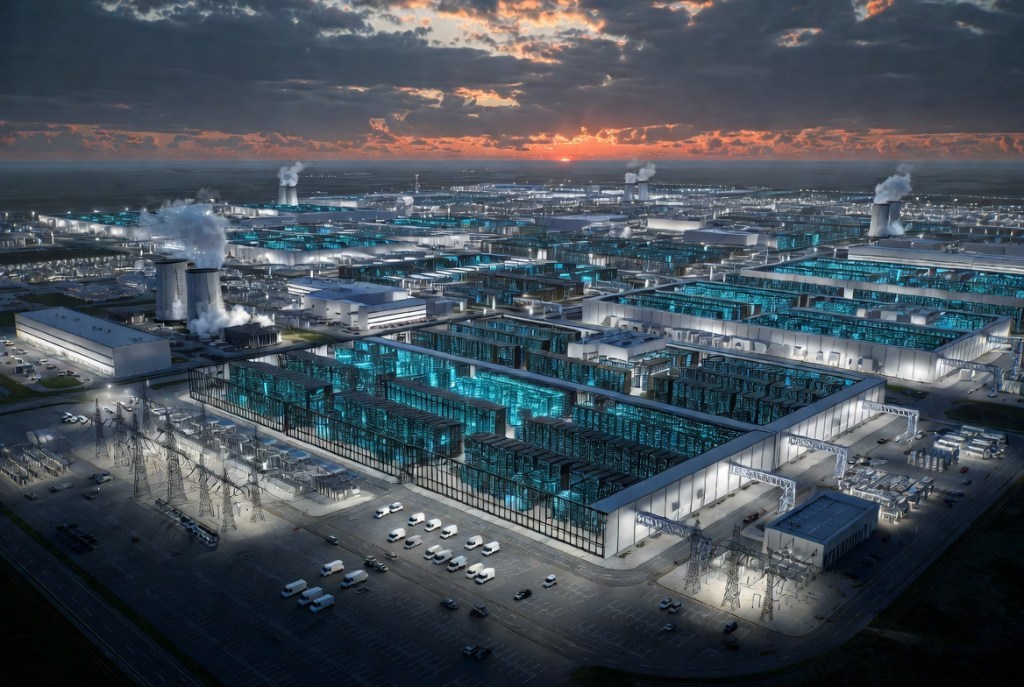
AI training data centers operate at a different order of magnitude. A single hyperscale AI campus today is being designed for one to two gigawatts of power draw. Plural gigawatts. That is, one to two thousand megawatts per campus. Per campus.
To put a single gigawatt in context: it is roughly the power output of a large nuclear reactor. It is also roughly the average power consumption of a city of half a million people. When a hyperscaler builds a one-gigawatt AI training facility, they are building, from the grid’s perspective, the equivalent of dropping a small city onto the system, in one location, all at once.
And they are not building one campus. Microsoft, Google, Amazon, Meta, and Oracle are each building multiple multi-gigawatt campuses, simultaneously, across multiple states. Then there are the OpenAI and xAI and CoreWeave and other dedicated AI infrastructure companies doing the same. And the regional utilities, all of them, are receiving interconnection requests for these campuses faster than they can process them.
Projections of how much electricity AI will consume by 2030 vary, but the credible range is roughly 300 to 500 terawatt-hours of new annual demand in the United States alone. The lower end of that range is bigger than the entire electricity consumption of California. The higher end is bigger than the entire electricity consumption of Germany. Either way, what we are talking about is adding the equivalent of one of the largest power-consuming economies in the world to the existing U.S. grid, in five years.
This was not in any utility’s planning model as recently as 2022.
The queue that never empties
When a new generation project or a new large customer wants to connect to the grid, they don’t just plug in. They enter what’s called an interconnection queue. The utility studies whether the existing transmission system can handle the new connection, identifies necessary upgrades, calculates who pays for what, and eventually issues the agreements that allow the connection to proceed.
This process has always taken time. But the data published by Lawrence Berkeley National Laboratory, which tracks the U.S. interconnection queue, shows that it has stopped functioning at the scale it now needs to operate. The current queue contains over two thousand three hundred gigawatts of proposed projects. That is roughly double the entire installed generation capacity of the United States. The queue contains, in proposed form, a second United States grid.
But the queue does not turn proposals into operating projects. Of all the projects that entered the queue between 2000 and 2019, only about thirteen percent had reached commercial operation by the end of 2024. The rest were withdrawn, cancelled, or still waiting after years of review.
Even projects that do get built spend an average of about five years in the queue before they begin operating. That number has been getting worse, not better, over the past fifteen years.
For a hyperscaler trying to build a data center that needs to be operational in 18 to 24 months, this is a structural impossibility. The grid expansion that would be required to serve them, on the timeline the regulated utility process can deliver, cannot happen in time. By the time the utility finishes the studies, files the rate cases, builds the new transmission line, and energizes the new substation, the data center has already been operating, or has already been abandoned.
So the hyperscalers stopped waiting.
Bring your own power
Sometime between late 2024 and early 2026, the hyperscaler industry made a strategic pivot that did not get much press coverage but is going to reshape American electricity infrastructure. They decided to stop relying on the public grid to power their AI data centers.
This is referred to in the industry as “behind-the-meter generation” or “bring your own power.” What it means in practice is that the hyperscaler builds its own dedicated power generation, on or adjacent to the data center site, and uses that generation as the primary power source. The grid connection becomes a backup, not the primary supply.
The scale of this pivot is remarkable. As of late 2025, industry trackers were following approximately forty gigawatts of announced behind-the-meter generation tied to specific data center projects. To repeat: that is forty thousand megawatts of dedicated power plants, mostly natural gas, being built outside the regulated utility planning process, on private timelines, by companies that are not in the power business and have never operated power infrastructure at scale.
The poster child for this strategy is xAI’s Colossus facility in Memphis, which Elon Musk built and brought online faster than any data center of comparable size in American history by deploying dozens of portable natural gas turbines on site, in many cases before the permits to operate them had been granted. The local air quality district and the Tennessee state environmental regulators have been playing catch-up ever since. Fines have been issued. Operations have continued.
The point is not that Musk is uniquely cavalier, although he might be. The point is that the economic logic of the AI buildout makes regulatory delays unacceptable to the companies building it. A hyperscaler that waits two years for permits while a competitor builds in six months loses the AI race. The decision tree is not really a tree at all. It is a single branch: build now, deal with consequences later. Pay the fines. Settle the lawsuits. Keep the data center running.
If you are a regulated utility trying to integrate this customer into your service territory, you are not actually negotiating with a customer. You are watching a customer build their own utility, on their own timeline, and asking you to please connect a backup line when you can.
The rules that don’t exist yet
The Virginia 2024 incident I wrote about in Post 2, in which sixty data centers disconnected in milliseconds, was not an isolated event. The North American Electric Reliability Corporation, NERC, has identified multiple similar incidents in both the Eastern Interconnection and the Texas grid since 2022. In each case, large computational loads have unexpectedly disconnected, in coordinated waves, in response to disturbances that the grid would normally have absorbed without incident.
In September 2025, NERC issued a Level 2 alert about this. A Level 2 alert is a regulatory step below an emergency, asking the industry to develop better practices for handling large computational loads. The response from the industry was, by NERC’s own assessment, inadequate. Most of the entities NERC asked to develop better practices did not develop better practices.
So on May 4, 2026, just two weeks ago, NERC escalated to a Level 3 alert. A Level 3 is the highest level of alert NERC issues. It identifies “essential actions” that grid operators and transmission planners must take to address an immediate reliability risk. NERC has not issued a Level 3 alert about large loads before. The previous Level 3 alert, issued in 2024, was about a different concern entirely, the behavior of solar and wind resources during grid disturbances.
The current alert reflects a regulatory body that has run out of patience with the pace of industry response. NERC’s modeling, published earlier this year, indicates that the coordinated disconnection of two thousand megawatts of data center load, which is well within the operational range of a single hyperscale campus, could destabilize twenty percent of the Eastern Interconnection. That would be a blackout on the same scale as 2003.
But here is the part that I find genuinely difficult to absorb. The Level 3 alert does not actually require data centers to do anything differently. It requires transmission planners and grid operators to study the problem, model the risks, and report back. The deadline for the initial response is August 3, 2026. The data center operators themselves are not directly bound by the alert at all.
The reason for this regulatory gap is structural. NERC’s mandatory reliability standards apply to entities classified as part of the Bulk Electric System, which historically has meant generators and transmission operators. Data centers, even gigawatt-class ones, are classified as customers. They are bound by their interconnection agreements with their local utility, but they are not subject to the same mandatory federal reliability standards that govern, say, a nuclear power plant or a regional transmission organization.
NERC is working on changing this. There is a process underway to create a new classification called a Computational Load Entity, which would subject large data centers to mandatory reliability standards. The estimated timeline for that process, according to industry analysts working on it, is somewhere between three and five years.
In the meantime, data centers continue to interconnect at the pace of new construction, under existing rules, with the kind of internal protection systems that produced the Virginia 2024 incident, on an honor system that depends on the data center operator picking up the phone when the grid operator calls.
The honor system problem
I want to spend a moment on this, because when I learned how the current coordination between data centers and grid operators actually works, I was genuinely surprised.
When a major grid disturbance happens and data centers trip themselves offline to backup power, the process of bringing them back online has to be staggered. If sixty data centers all reconnected to the grid simultaneously, you would create the opposite problem from the disconnection, an instantaneous fifteen-hundred-megawatt load step that the grid would have to absorb in the other direction.
The way this is currently managed is largely by phone call. The grid operator’s control room calls the data center operations centers. They coordinate a staggered reconnection. The data centers cooperate.
There is no technical mechanism that prevents a data center from reconnecting whenever it wants. The automatic transfer switches that physically reconnect the facility to the grid are owned and controlled by the data center, not the utility. The utility could, in an extreme case, manually open the breaker on its side of the connection, but this is a last-resort action, not an automated safety system.
The entire system depends on the data center operator choosing to cooperate. Which has worked so far, because the operators involved have been hyperscalers with sophisticated operations teams who understand the consequences of uncoordinated reconnection and have working relationships with their grid operators. But it depends on goodwill, scaled, in an industry where the willingness to pay fines as a cost of operating quickly is a documented business strategy.
A senior grid planner I read recently put it bluntly: the current arrangement works because the number of relevant data center operators is small enough to coordinate by phone. As that number grows, and as the diversity of operators grows beyond a handful of hyperscalers to include hundreds of smaller AI startups, colocation providers, and crypto miners, the assumption that everyone will cooperate becomes thinner.
The collision
So here is where we are.
The AI industry is building data center capacity that will dwarf any new demand source the U.S. grid has absorbed in its entire history. The companies building it are doing so on private timelines, with private generation, often outside the regulated planning process, in many cases without waiting for the permits that would normally be required. The regulatory body responsible for grid reliability has acknowledged that current rules are inadequate but cannot create new rules faster than the buildout proceeds. The technical coordination between data centers and the grid is governed largely by phone calls and cooperative agreements that depend on goodwill.
This is the operating condition of American electricity infrastructure right now. Not a future scenario. The current reality.
The grid will not collapse next week. The grid is more resilient than this description might suggest, because of the decades of engineering and regulatory effort that went into making it resilient. But the margin of safety that grid planners used to be able to count on is shrinking, fast, and the people responsible for managing the system are publicly acknowledging that they cannot keep up with the pace of change.
In the final post in this series, I want to bring all of this back to where we started. What does any of this mean for someone like me, a residential customer in Missouri running a dishwasher at ten PM? What is going to happen to my electric bill, and to yours? And what, if anything, can ordinary ratepayers actually do about it?
That’s next week.
Next Sunday: Why Your Electric Bill Is About to Get Weirder. What the AI buildout means for the rest of us, and what we can actually do.

